
Strategy and Targets
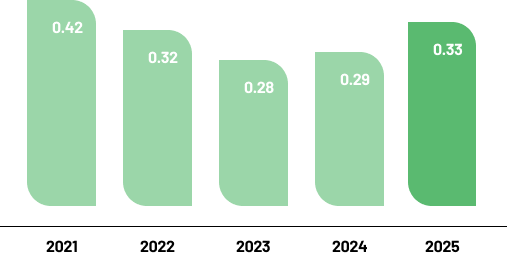
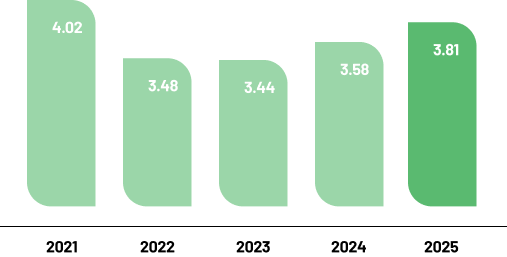
Monde Nissin's long-term environmental ambition under the Planet Pillar includes reducing the GHG intensity of our manufacturing operations. This is reflected in our target to achieve a 50% reduction in Scope 1 and Scope 2 GHG intensity by 2025, using 2021 as the baseline. Scope 3 emissions are not yet disclosed.
50% reduction in Scope 1 and Scope 2 GHG intensity by 2025
(vs. 2021 baseline)
Operational Integration

Governed by Environmental, Energy, Health and Safety (EEHS) Policy

Accountability at Every Site

Performance through Discipline
Energy use and fuel consumption are managed through operational controls applied across manufacturing sites. Energy considerations are integrated into production planning and capacity decisions to manage the impact of operational growth on emissions performance and maintain efficiency. This operational discipline is guided by the Company's Environmental, Energy, Health and Safety (EEHS) Policy, which provides the comprehensive framework for compliance, monitoring, and operational controls across manufacturing sites.
To monitor performance in meeting standards, each site designates a Pollution Control Officer (PCO) responsible for emissions monitoring, permit management, and regulatory reporting. This role is closely integrated into engineering and operations teams, enabling compliance requirements to directly inform day-to-day decision-making.
Emissions management is treated as an operational discipline rather than a standalone initiative. Site teams apply standardized reviews of combustion efficiency, steam system performance, compressed air use, chiller demand, and energy consumption patterns to support more consistent decision-making across plants.
The Company continues to monitor evolving regulatory and reporting developments, including anticipated requirements under ISSB standards.
During the transition period leading to FY 2028, Monde Nissin intends to progressively strengthen its Scope 3 measurement capabilities, subject to the availability of reliable data, appropriate methodologies, and established reporting boundaries.
Progress and Actions
In 2025, emphasis was placed on strengthening fuel flexibility, improving recovery of high-emission fuels such as LPG, and refining daily monitoring practices to stabilize energy performance across varying production conditions. Energy efficiency initiatives were implemented across selected manufacturing sites, including equipment optimization and enhanced monitoring of consumption patterns. While site-level efficiency gains were realized, overall emissions performance continued to reflect production volumes and distribution activity during the year, with logistics-related considerations discussed separately below.
Scope 1 and Scope 2a GHG Intensity Across Monde Nissin's Manufacturing Sites
(in tonnes CO2e/tonne of product produced)
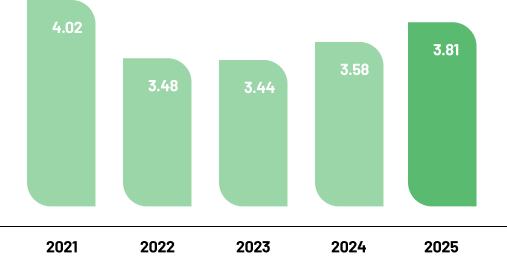
Energy Intensity Across Monde Nissin's Manufacturing Sites
(in GJ/tonne of product produced)
a Market-based Scope 2 emissions was used for calculating Scope 1 and Scope 2 GHG Intensity
A key priority in 2025 was reducing dependence on high-emission fuels, particularly coal, while strengthening the reliability of our energy supply. At the Porac plant, the full utilization of a newly installed boiler improved combustion efficiency and reduced coal consumption by 25% during specific operating periods. The Company shifted from cost-based to performance-based supplier evaluations, assessing coal quality through indicators such as consumption rates and ash generation.
At the Santa Rosa plant, Monde Nissin introduced building management systems at key sites to automate Heating, Ventilation, and Air Conditioning (HVAC) controls for biscuit, cake, and wafer lines. This transition to computer-based operations for chillers, cooling towers, and pumps allowed for real-time optimization of cooling alignment, enhancing both energy efficiency and operational safety. Boiler operations were further optimized through the implementation of Rule-Based Control (RBC) and standardized operational strategies. A significant outcome of this effort was the ability to reduce active boiler requirements from three units to two while maintaining full capacity for six noodle production lines. This was implemented at the plant in December 2025.
At the Malvar plant, emissions were further reduced through enhanced power supply stability, which lowered reliance on generators by 80% compared to previous cycles. Beyond manufacturing, the newly launched Monde Fresh Express pilot electric vehicles for baked goods distribution on high-frequency urban routes, replacing conventional fuel-powered vans to reduce tailpipe emissions and noise. These initiatives reflect a broader focus on managing emissions across both production and distribution, where operational choices have a direct and measurable impact on environmental performance.
Additional information regarding emissions and compliance can be found under Emissions Management and Environmental Compliance in the Environmental Disclosures page.

Logistics Emissions and Operational Considerations
Logistics-related emissions form part of Monde Nissin's overall GHG profile and are influenced by production volumes, distribution reach, and transport requirements. Unlike manufacturing emissions, logistics emissions are affected by routing decisions, load utilization, and external service providers.
In 2025, logistics planning measures such as route optimization and load reviews were applied to improve delivery efficiency where operationally feasible. However, increased distribution activity during the year influenced overall logistics emissions, reflecting the interaction between efficiency efforts and volume-driven demand. These observations informed refinements to logistics planning and emissions monitoring practices during the reporting period.
Energy Intensity Across Monde Nissin's Manufacturing Sites
(in GJ/tonne of product produced)
Monde Nissin adheres to applicable environmental and energy regulations, including the Philippine Clean Air Act (RA 8749) and its Implementing Rules and Regulations (DAO 2000-81), the National Emission Standards for Source Specific Air Pollutants (NESSAP), and the Energy Efficiency and Conservation Act (RA 11285).
To support these standards, procedures and documentation for fuel quality monitoring, operating conditions of Air Pollution Source Equipment (APSE), and maintenance of Air Pollution Control Facilities (APCF) were further strengthened. These refinements support more consistent emissions management and align regulatory compliance with day-to-day operational performance objectives. Beyond compliance, these standards support day-to-day operational discipline as we work to manage air emissions, improve energy efficiency, and reduce our environmental footprint through practical site-level actions.
The Company integrated biomass fuel mixing at the Porac plant, utilizing the hybrid boiler's capability to process alternative fuels such as oil and noodle rejects. At the Mandaue plant, similar biomass utilization practices were applied, with product scraps temporarily used as alternative fuel during periods of cocoshell scarcity to sustain boiler operations. At the Santa Rosa plant, testing and evaluation of agricultural waste and other renewable biomass materials continued to assess technical feasibility for potential longer-term integration. As part of these evaluations, poultry-derived biomass pellets were trial-tested in November 2025 to assess combustion performance and operational compatibility. Any future use remains subject to technical validation, applicable regulatory requirements, and the availability of suitable fuel sources. In parallel, the Malvar plant advanced LPG recovery and optimization initiatives, including boiler recalibration and improved steam system management to reduce fuel losses and improve combustion efficiency. A significant milestone was the reduction in steam usage per kilogram of finished goods, achieved through the standardization of steam operations and optimization of boiler pressure. Across selected plants, fuel strategies were further refined in response to supply conditions, supported by strengthened boiler and steam system controls and enhanced daily monitoring of power consumption at line and utility levels. Adjustments to operating parameters, combined with closer coordination between engineering and production teams, helped stabilize energy performance under varying production demands.
Additional targeted investments included the installation of variable frequency drives (VFDs) for chiller operations and the enclosure of production areas to reduce energy demand. Together, these site-level refinements demonstrate how disciplined operational controls—applied consistently and adjusted as conditions evolve—contribute to improved fuel efficiency and more predictable power consumption trends across manufacturing operations.
Implementation planning for these recommended actions was initiated in 2025. In parallel with efficiency and emissions reduction efforts, renewable energy sourcing formed part of the Company's broader decarbonization approach. Energy procurement and site-level renewable integration were managed alongside operational efficiency initiatives to support lower-emission manufacturing. A detailed breakdown of our energy consumption and compliance can be found under Energy Management and Environmental Compliance in the Environmental Disclosures page.

Expanding Renewable Energy Across Manufacturing Sites
Early adoption efforts integrated renewable technologies into existing energy systems across manufacturing sites. As implementation progressed, improved monitoring provided clearer visibility into the contribution of renewable sources to overall electricity consumption.
In 2025, electricity consumption across manufacturing sites was sourced from 86% geothermal energy, 1% solar energy, and 13% non-renewable energy.
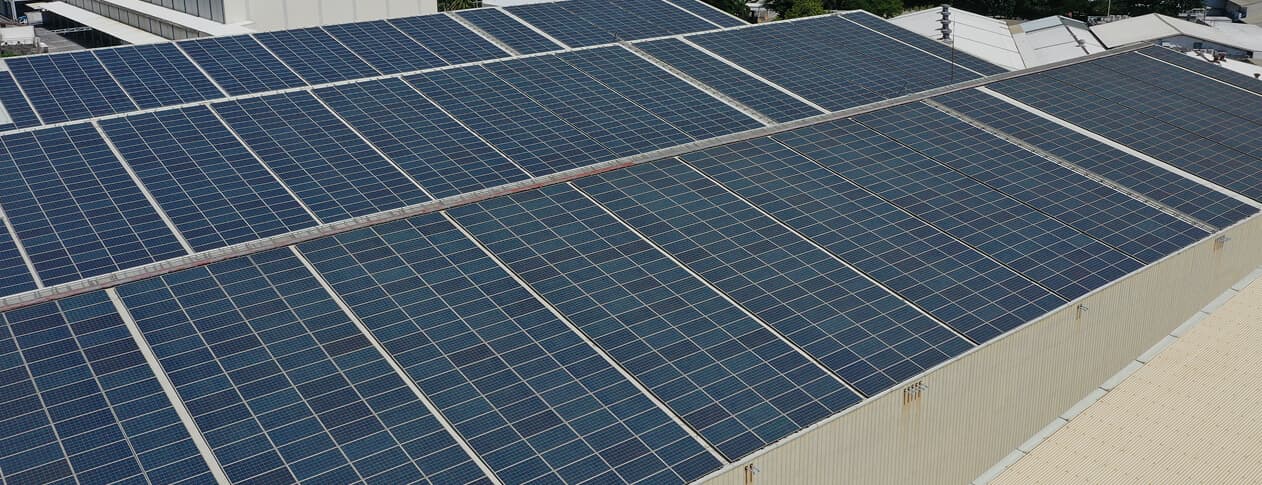
Solar installations provide on-site renewable generation and help offset grid electricity demand. As of 2025, solar energy systems are installed at the Santa Rosa site, with a combined installed capacity of 1.3 MW.
Through collaboration with the Energy Development Corporation (EDC), selected sites source geothermal electricity to support lower-emission manufacturing. Sites powered by geothermal energy include manufacturing sites in Malvar, Mandaue, Porac, and Santa Rosa, accounting for 86% of total electricity consumption.