
Strategy and Targets
Water is an important input to Monde Nissin's manufacturing operations and is managed with attention to operational efficiency, wastewater treatment, and site-specific water risk conditions. The Company's priority is to reduce water intensity while maintaining responsible withdrawal, use, and discharge across all manufacturing locations.
Water stewardship is implemented through plant-level efficiency controls, recovery and reuse systems, wastewater treatment processes, and structured monitoring of consumption and discharge. Management practices are adapted to local infrastructure conditions, regulatory requirements, and production profiles to support consistent performance across sites.
Monde Nissin set a 2025 target to reduce water intensity in manufacturing operations by 50%, using 2021 as the baseline, in line with its broader Planet ambition to improve eco-efficiency across resource use guiding capital investments, operational controls, and site-level process improvements.
50% reduction in water intensity by 2025(vs. 2021 baseline)

Efficiency Controls

Recovery and Reuse Systems

Wastewater Treatment Processes

Monitoring and Management
In 2025, emphasis was placed on strengthening water recovery systems, enhancing visibility into plant-level water flows through mapping initiatives, and reinforcing preventive leak detection and line audits to support sustained efficiency gains.
Progress and Actions
In 2025, water efficiency measures continued across manufacturing sites, with emphasis on optimization and recovery initiatives that delivered measurable reductions in water consumption. Actions included process improvements, strengthened leak detection, and expanded water reuse practices adapted to site conditions and operational requirements.
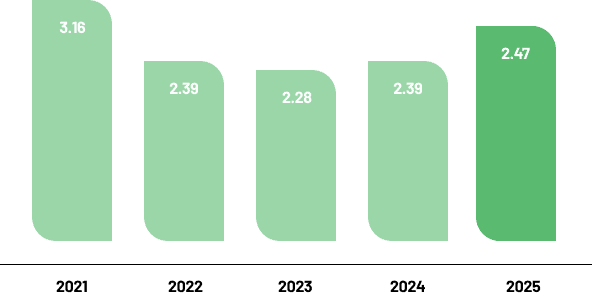
Water Intensity Across Manufacturing Sites
(in m3/tonne of product)
At the Mandaue plant, initiatives included repairing water line defects, implementing a condensate recovery system to reduce boiler freshwater use, and reusing treated wastewater for boiler scrubbers. At the Malvar plant, detailed water mapping and related initiatives enhanced visibility into plant water flows and supported efforts to reduce withdrawal from other water supplies by 20–30%. Filtration systems were also introduced in water handling areas to eliminate the need for weekly chlorination.
Across sites, teams conducted regular walkthroughs during planned downtimes to identify leaks and losses. Additional recovery initiatives, including backwash recovery at water treatment facilities, further reduced raw water consumption. At the Porac plant, reuse of reverse osmosis (RO) concentrate and the commissioning of a new boiler improved water efficiency and generated operational cost savings. Similar RO reject recovery practices were implemented at the Santa Rosa plant, reinforcing reuse as a routine operating practice.
Water consumption and discharge continued to be monitored in accordance with regulatory requirements, and wastewater treatment systems operated across sites to support compliance with effluent standards. In 2025, water line audits were conducted more frequently to detect inefficiencies and potential losses, supported by improved water flow mapping. Where monitoring identified performance gaps, maintenance activities and operational adjustments were implemented during the year. For more information on our water consumption and compliance, see Water Management and Environmental Compliance in the Environmental Disclosures page.
Experience from implementing these measures reinforced the importance of site-specific approaches, particularly in locations with varying water availability, infrastructure capacity, and production requirements.